Crypto bridge vs swap: how to move coins between networks without ending up with a receipt instead of money
There are two ways to move coins from one network to another. A bridge locks them on one blockchain and mints a wrapped copy on another. A swap is simpler: you give a coin on one network and receive a native coin of another network at your own address. After the bridge hacks and the frozen Liquid redemptions, that difference started to cost money. Below we cover what you risk in each case, when a bridge is unavoidable and how to move USDT from ERC20 to TRC20 with a swap.
What a crypto bridge is and how it works
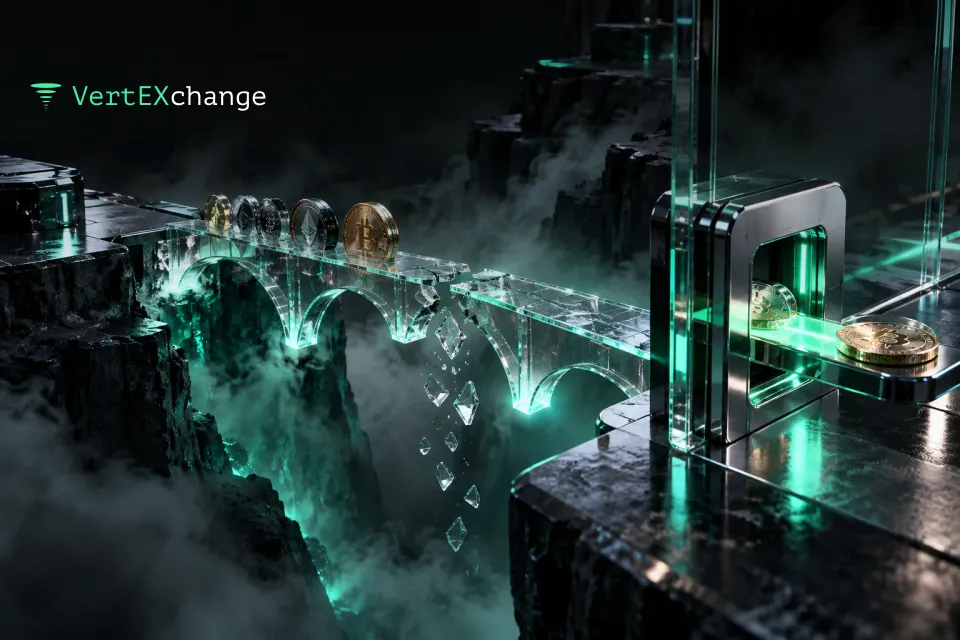
Blockchains cannot see each other. Ethereum has no idea what happens on TRON, and Bitcoin can read neither of them. You cannot send a coin "to another network" directly, so someone has to take it here and hand it out there. A bridge does this with a scheme called lock-and-mint.
- You send coins to the bridge contract or address on the source network. They stay locked there.
- The bridge mints the same number of receipt tokens on the destination network. These are called wrapped tokens.
- To go back, you burn the wrapped tokens and the bridge unlocks the original coins.
A wrapped token is worth as much as the original only while the collateral is in place and the bridge is ready to return it. WBTC on Ethereum is a receipt for bitcoin held by a custodian company. L-BTC on the Liquid sidechain is a receipt for bitcoin managed by a federation of members. In a bridge between Ethereum and a layer 2 network, a smart contract holds the collateral.
Who holds the collateral is the main question to ask about any bridge. It can be code, a multisig with several keys, or a single company. In every case you trust your coins to whoever has the key to the lock, and you trust them not for the minute of the transfer but for as long as you own the wrapped token.
There are also bridges of another kind, built on liquidity pools. Reserves of coins sit on both sides in advance, and you get a ready token from the pool, with no receipt. But pools live in smart contracts too, and a bug in the code hits them just the same.
What happens when a bridge breaks
Liquid is the fresh example. On September 6, 2026, a bug in the Elements software let about 4,000 BTC leave the sidechain's reserve. 3,400 were recovered, but the reserve covers only 85.8%, and as of October 11 L-BTC redemptions for bitcoin have been frozen for 35 days. The tokens themselves went nowhere, and L-BTC still sits in people's wallets. What disappeared is the ability to turn it back into bitcoin.
This is what a typical failure looks like: you hold the receipt, and the collateral is in doubt. September 2026 was in fact the worst month of the year for crypto hacks. By CertiK's count about $766.4 million was stolen, and Liquid is the second largest case on that list. The story is not new: according to Chainalysis, about $2 billion was taken from bridges in 2022, nearly 70% of all crypto stolen that year.
A bridge can let you down without a hack as well. On October 2 the layer 2 network Blast announced it was shutting down and asked users to withdraw everything to Ethereum by October 26. The money will not vanish after that date, but you will have to claim it directly through the bridge contract, and we have already covered how to withdraw ETH and USDB from Blast while the regular interface still works.
What a cross-chain swap is
A swap works without a lock and without a receipt. You send a coin on one network to the service's address, and it sends you a coin on another network. You end up with a native asset: real BTC on the Bitcoin network, ETH on Ethereum, USDT that Tether itself issued on TRON. There is no wrapped token, and nobody's collateral to watch after the swap.
This is how a crypto exchange without registration works. You pick a pair, enter your address on the network you need, send your coins and receive the others. Different assets are swapped the same way: you can swap BTC to ETH without registration and receive ether on mainnet, not a wrapped token.
There is trust here too, and there is no point in hiding it: while the swap is in progress, your coins are with the service. The difference is the duration. The swap ends when the coins reach your address, and from then on you depend on no one. With a wrapped token you depend on the bridge every day you hold it.
Bridge vs swap: a comparison
| Question | Bridge | Swap through an exchange service |
|---|---|---|
| What you get | a wrapped token or the same asset on another network | a native coin of the target network at your own address |
| Who you trust | the bridge contract and whoever holds the collateral, for as long as you own the token | the service, for the duration of the swap |
| What can break | a contract hack, stolen collateral, frozen withdrawals, a network shutting down | a delayed swap, a wrong address or network on your side |
| Speed | from minutes to seven days when withdrawing from some layer 2 networks | depends on confirmations on both networks |
| Fees | gas on the source network, often on the destination too, a token approval, the bridge fee | the network fee for sending, the rest is already included in the amount you receive |
| What you need | a web wallet, a connection to the contract, a coin for gas | a receiving address and a coin for the fee on the sending network |
A swap is not always cheaper than a bridge. Sometimes a bridge charges less, especially for a large amount between two Ethereum networks. But the outcome of a swap is visible in advance: the form shows the amount you will receive before you send any coins, while bridge costs add up from several transactions on two networks.
When you really need a bridge
- You are moving to a layer 2 network such as Arbitrum, Base or Optimism and want to use its apps. The official bridge of such a network is built into the network itself, with no outside service involved.
- A token exists on one network only, and you need it in DeFi on another. There is nothing to swap it for, so a wrapper is what remains.
- You need bitcoin inside smart contracts, for a loan or a pool on Ethereum. BTC itself cannot work there, only its wrapped version can.
- You are moving a large amount between networks of one ecosystem and are ready to find out who holds the collateral.
In all these cases a bridge is a working tool. Keep in wrapped tokens only what the job requires, and no longer than it requires.
When a swap is simpler
- The asset is already issued on both networks. USDT exists on Ethereum, TRON, Solana and TON, and a wrapper is unnecessary here.
- You are changing one coin for another across networks: bitcoin for ether, USDT for Monero. A bridge will not help with that, it moves an asset and does not change it.
- You need the coin to hold or to pay with, not to put to work in DeFi.
- You do not want to connect your wallet to an unfamiliar contract and sign token approvals.
Mistakes when moving coins between networks
- A 0x address is the same on Ethereum, BNB Smart Chain, Arbitrum, Base and Polygon, and your wallet will not warn you that the wrong network is selected. Check the network on both the sender's and the recipient's side before every transfer. If the transfer has already gone out, see the guide on what to do when you sent USDT to the wrong network.
- A wrapped token is easy to mistake for the native one. USDC.e, WBTC and BTCB are different assets with different collateral, and an exchange may not credit a token that is "almost the same". Look at the full name and the contract address, not just the ticker.
- For XRP, XLM and USDT on TON, exchanges often ask for a memo or tag. Without it the money lands at the exchange's shared address and is not credited until you prove the transfer is yours.
- A bridge needs the network's coin for gas. The wrapped token has arrived, there is nothing to pay the fee with on the new network, and it just sits there.
- Fake bridge sites trick you into signing a token approval. Open a bridge from a link in the network's documentation, not from a search ad.
How to move USDT from ERC20 to TRC20 with a swap
Moving a stablecoin from Ethereum to TRON is the most common case where no bridge is needed, because Tether itself issues USDT on both networks. The whole path takes six steps.
- Open the pair. "You send" is USDT ERC20, "you get" is USDT TRC20. At VertEXchange you can exchange USDT ERC20 to TRC20 right from the pair page.
- Enter the amount. The form shows how much USDT will arrive on TRON before you send anything.
- Paste the receiving address on the TRON network. It starts with the letter T and has 34 characters, and a 0x address will not work here.
- If the form offers a refund address field, enter your Ethereum address. The coins return there if the swap does not go through.
- Send USDT on the Ethereum network to the address you are given, exactly the amount stated in the order. Your wallet needs ETH for gas.
- Watch the status on the swap page. Once the USDT is sent to you, a transaction hash appears, and you can check the transfer in a TRON explorer.
Receiving USDT on TRON is free, the sender pays the fee. To send it on later, though, you will need a little TRX. Before a large amount, send a test one: the fee for a test is cheaper than a mistake.
Where to exchange USDT ERC20 to TRC20 without registration
VertEXchange swaps coins between networks with no account, email or phone number. You do not connect a wallet to the site, and nobody asks for token approvals. You send the transfer yourself to the address in the order, and the USDT on the new network comes straight to your address.
The form shows the rate and the amount you will receive before you send, so you decide already knowing the result. Keys and a seed phrase are not needed for a swap, and the service never asks for them.
- A fixed rate holds for about 15 minutes, and it is not available for every pair.
- The coins go straight to your address, the service does not hold them.
- You can add a refund address in case the swap does not go through.
- Personal fields of the operation are deleted 24 hours after completion, and the swap history stays only in your browser.
- A support chat is on every page, and questions are resolved by swap code.
The way back works the same: you can convert USDT TRC20 to ERC20 when you need stablecoins on Ethereum. And if your USDT sits on BNB Smart Chain, you can swap USDT BEP20 to TRC20 in the same way.
FAQ
Which is safer, a bridge or a swap?
They carry different risks. With a bridge you depend on the contract and the collateral for as long as you hold the wrapped token. With a swap you trust the service only for the duration of the operation and end up with a native coin at your own address.
What is a wrapped token?
A receipt for a coin locked on another network. It is worth as much as the original while the collateral is in place and the bridge is ready to exchange it back.
Can I move USDT from ERC20 to TRC20 without a bridge?
Yes. Tether issues USDT on both networks, so a USDT to USDT swap is enough: you send on Ethereum and receive on TRON.
How is a bridge different from a DEX swap?
A swap on a decentralized exchange changes one token for another inside a single network. A bridge moves the same asset to another network. A swap through an exchange service gives you a different coin on a different network in one operation.
How long does a bridge transfer take?
From a few minutes to seven days. A week is what a withdrawal takes through the official bridges of some layer 2 networks: that is how long the window lasts in which a transfer can be challenged.
What happens to wrapped tokens if the bridge is hacked?
The tokens stay in your wallet, but the collateral behind them may fall short. Withdrawals are then paused, and the market price of the wrapper can drop below the original.
No email, no account: enter your wallet address, send your coins and get the new ones straight to it.
Swap USDT ERC20 to TRC20