Ethereum gas fees in 2027: why they get high and how to pay less
In 2027, Ethereum gas is still the main question for anyone sending ether and USDT ERC-20: why the transfer cost more than expected, and why the transaction got stuck. As of October 15, 2026, an ETH transfer costs less than a cent, but in a market crash the gas price can jump hundreds of times within minutes. We break down what the fee is made of, why it gets high, why gas is charged even for a failed transaction and how to pay less.
What gas is
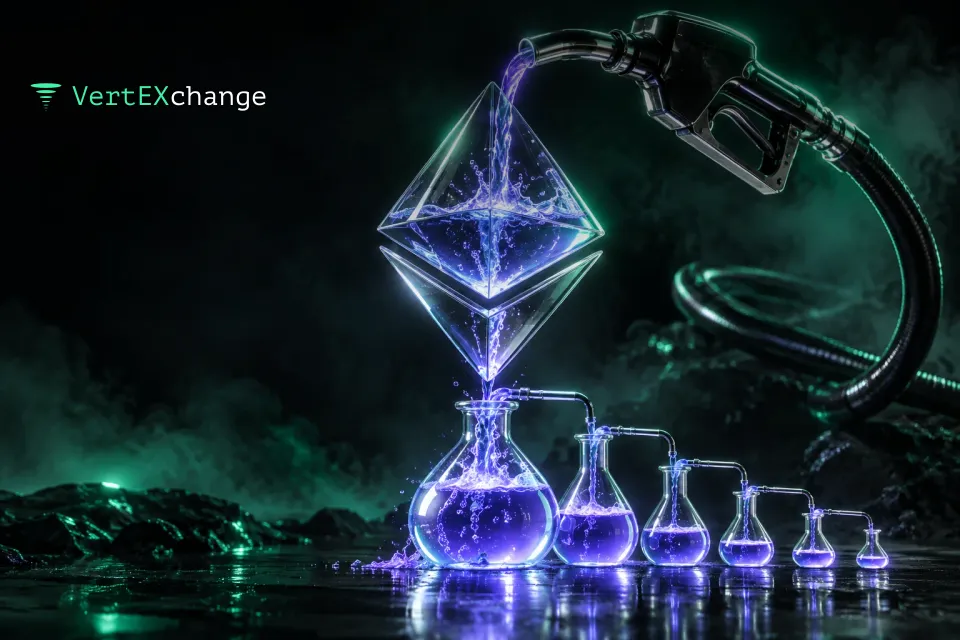
Gas is what the Ethereum network charges for the work validators do on your transaction. Every action costs a set number of gas units: a simple ether transfer takes exactly 21,000 units, while a token transfer or a smart contract call takes more, because the contract runs more operations.
The price of one gas unit is counted in gwei. A gwei is one billionth of an ether: 1 gwei = 0.000000001 ETH. The total fee works out like this:
fee = gas units × (base fee + tip)
The base fee is set by the protocol itself, and it is burned: that ether leaves circulation for good and nobody receives it. This is how EIP-1559 works, the upgrade that has been live since 2021. The tip (priority fee) goes to the validator who includes the transaction in a block: the higher it is, the more eagerly your transaction gets picked first. In your wallet you also set a maximum you are willing to pay per gas unit. If the actual price turns out lower, you get the difference back.
How much gas different actions use
The figures below are estimates for Ethereum mainnet as of October 15, 2026, taken by querying a network node. Actual usage is usually a little below the estimate.
| Action | Gas units |
|---|---|
| ETH transfer | 21,000 |
| USDT transfer to someone who already holds USDT | about 46,500 |
| USDT transfer to a new address | about 64,000 |
| Approval (approve) for USDT | about 49,000 |
Sending USDT to an "empty" address costs more because the contract has to create a new balance record. A swap on a decentralized exchange costs even more: at Etherscan Gas Tracker prices, it comes out roughly 15–20 times more expensive than a simple transfer.
How much a transfer costs in October 2026
Right now gas on Ethereum is cheaper than ever. On October 15, 2026, at around 09:17 UTC, the base fee on Etherscan Gas Tracker was about 0.064–0.071 gwei, with ether trading at around $2,375. An ETH transfer cost roughly $0.003, a USDT transfer about one cent, and a swap on a decentralized exchange about $0.05. If you swap coins through a crypto exchange, the gas for sending your ether is barely noticeable next to the amount you exchange.
Layer 2 networks (L2) are cheaper still. Median fees on the morning of October 15, according to growthepie:
| Network | Transfer | Swap |
|---|---|---|
| Ethereum | $0.0049 | $0.052 |
| Arbitrum | $0.001 | $0.011 |
| Base | $0.0003 | $0.0034 |
| OP Mainnet | $0.0001 | — |
| zkSync Era | $0.010 | $0.024 |
The gap between mainnet and L2 is now a fraction of a cent. It was not always like this: in May 2021, according to FXStreet, users paid more than 2,000 gwei per gas unit, tens of thousands of times more than today.
Why gas fees get high
If it is this cheap now, why do people complain about expensive gas? The gas price is an auction for space in a block, and it climbs fast when there is not enough space.
- Demand spikes. Every block has a target load of half the limit. When blocks fill up beyond the target, the base fee rises by up to 12.5% per block, that is, every 12 seconds. Ten full blocks in a row, and gas costs three times as much. On October 10, 2025, during a market crash with mass liquidations, network fees for the day topped $13.8 million according to Block Scholes, and the next day they fell to about $2 million.
- Complex contracts. A swap, a loan or an NFT mint takes many times more gas units than a transfer. The price per unit is the same, but the total is 10–20 times higher.
- A maximum set too low. If you set a maximum price below the current base fee, the transaction does not disappear; it sits in the queue until gas gets cheaper. From the outside it looks like a "stuck transfer."
Why the fee was charged but the transfer failed
Gas pays for the work, not for the result. If a transaction fails with an error, for example the contract rejects the operation or the allotted gas runs out (an "out of gas" error), all changes are rolled back, but the gas spent is still charged. That is why a block explorer can show a transaction with the status Fail and a fee taken. We covered how to find and read such a record in our guide on how to check a transaction by hash.
Why gas got cheaper
Cheap gas is the result of several network upgrades in a row.
- Dencun, March 13, 2024. Introduced "blobs" (EIP-4844), cheap temporary data storage for L2s. L2 fees dropped tens and hundreds of times: right after the upgrade, Base's median fee fell from about $0.50 to $0.0012, according to The Block.
- Pectra, May 7, 2025. Doubled the target number of blobs per block and gave regular addresses smart wallet features (EIP-7702), including having someone else pay gas for the user.
- Fusaka, December 3, 2025. Added PeerDAS: validators no longer need to download all L2 data in full, so blocks could carry even more blobs.
- Block gas limit. Validators raised it by signaling, without a hard fork: from 30 million to 36 million in early 2025, to 45 million in July 2025, and to 60 million in late November 2025. More space in a block means less of an auction for it.
The next major upgrade, Glamsterdam, has been live on the Sepolia testnet since October 6, 2026, and no mainnet date has been set yet. What it will change for gas prices we explained in our breakdown of what Glamsterdam will change in Ethereum.
How to pay less for gas
- Check the price before you send. Etherscan Gas Tracker shows the current base fee, and growthepie compares L2s. If gas is suddenly dozens of times higher than usual, something is probably happening in the market, and within an hour it may come back down.
- Do not set the maximum too tight. Your wallet suggests a price with a buffer, and that buffer is not lost: the excess comes back to you. A maximum that is too low leaves you with a stuck transfer.
- Speed up and cancel the right way. In MetaMask, the "Speed up" button resends the same transaction with the same sequence number (nonce) and a higher fee, so you will not pay twice. "Cancel" is a 0 ETH transfer to yourself with the same number and a fee at least 10–30% higher. A transaction that is already confirmed cannot be canceled.
- Do not hand out extra approvals. Every approve is a separate transaction of about 49,000 gas units and open access to your tokens. It is better to revoke token approvals once you have checked them than to pay for them and take the risk.
- Move frequent small operations to L2. For dozens of small transfers, Arbitrum or Base is cheaper, although at today's prices the difference is a matter of cents.
USDT on Ethereum: what you need to know about gas
Gas on Ethereum is paid only in ether. If an address holds USDT on ERC-20 but not a drop of ETH, you will not be able to send that USDT anywhere: first you have to top up the address with ether. The easiest way is to buy some ether with USDT on TRON straight to that address. This is the most common reason behind "the money is in the wallet, but I can't send it." TON usually works the same way: the fee for a USDT transfer is paid in TON.
At the same time, ERC-20 is not the most expensive network for USDT right now. On TRON, after the energy price cut on August 29, 2025, a transfer to someone who already holds USDT costs about 6.4 TRX, and to a new address about 13.4 TRX. With TRX at $0.33, that is roughly $2.1 and $4.4, while a USDT transfer on Ethereum costs about a cent today. We wrote separately about which network to send USDT on, TRC-20 or ERC-20, and how much a USDT transfer on TRON costs with and without energy. Gas on Ethereum can get expensive again in any crash, so it makes sense to choose the network at the moment of the transfer rather than once and for all.
How to exchange ether without registration or extra steps on VertEXchange
An exchange on VertEXchange is a single transfer from your wallet: you pay the network gas for sending your ether and sign nothing else. No token approvals, no connecting your wallet to a website, no approve you have to revoke later. No account, email or phone number is needed: you enter a receiving address and send your coins.
- The rate and the amount you will receive are shown before you send, and a fixed rate holds for about 15 minutes.
- Coins arrive straight at your address; the service does not hold them.
- If the exchange does not go through, the coins are returned to your refund address.
- Personal fields of the operation are deleted 24 hours after it is completed.
- Support chat is available on every page, by exchange code.
You can exchange ETH to BTC without registration or move stablecoins between networks if you need to swap USDT ERC-20 to USDT TRC-20, and receive the coins right at your own address.
FAQ
Why are Ethereum gas fees so high?
Right now they are not high: in October 2026, an ETH transfer costs a fraction of a cent. Gas gets expensive during demand spikes, when blocks are overloaded and the base fee rises by up to 12.5% per block, and in complex operations such as a swap on a decentralized exchange, which needs dozens of times more gas units.
How much does an Ethereum transaction cost in 2027?
It cannot be predicted exactly: the gas price changes every 12 seconds. On October 15, 2026, an ETH transfer cost about $0.003, and a USDT transfer about a cent. Etherscan Gas Tracker shows the current price.
What is gwei?
The unit of the gas price, one billionth of an ether: 1 gwei = 0.000000001 ETH. The fee is the number of gas units multiplied by the price in gwei.
Why was I charged gas if the transaction failed?
Gas pays for computation, not for the result. If a transaction fails, for example because of an "out of gas" error, the changes are rolled back, but the gas spent is not refunded.
Why can't I send USDT ERC-20?
Most likely there is no ether on the address to pay for gas. On Ethereum, gas is paid only in ETH, so an address with USDT needs a little ether on it.
How do I speed up a stuck Ethereum transaction?
In your wallet, tap "Speed up": it will resend the same transaction with the same sequence number and a higher fee. You can also cancel it by sending 0 ETH to yourself with the same number and a higher fee. A confirmed transaction can be neither sped up nor canceled.
No email, no account: enter your wallet address, send your coins and get the new ones straight to it.
Exchange ETH to BTC